
Warm and Beloved: Makerspace Saturdays
by Allison Brown Indulge with me, for a moment, a brief bit of time travel as we go back to a Saturday morning in early

by Allison Brown Indulge with me, for a moment, a brief bit of time travel as we go back to a Saturday morning in early

by Mary E. Johnson When Dorothy Day died in 1980, the New York Times eulogized her as “a nonviolent social radical of luminous personality.” Day

Her names alone can add confusion…Bride, Brid, Brigon, Brigitta, Brigantia – and so on. At various times she’s been called the patron saint of poets, midwives, newborns, Irish nuns, fugitives, blacksmiths, dairy maids, boatmen, chicken farmers, cattle, scholars, sailors and more!

“I am a lifelong Episcopalian and a Mathematician by vocation.”

Superbowl Sunday, I walked into church weary. I was feeling like an imposition, a fraud, exhausted, devastated, overwhelmed, angry, and lonely. Weariness had me dreading the rest of the day.

“Everyone has regrets, but this book provides a path forward to live with serenity and how to accept change gracefully.”
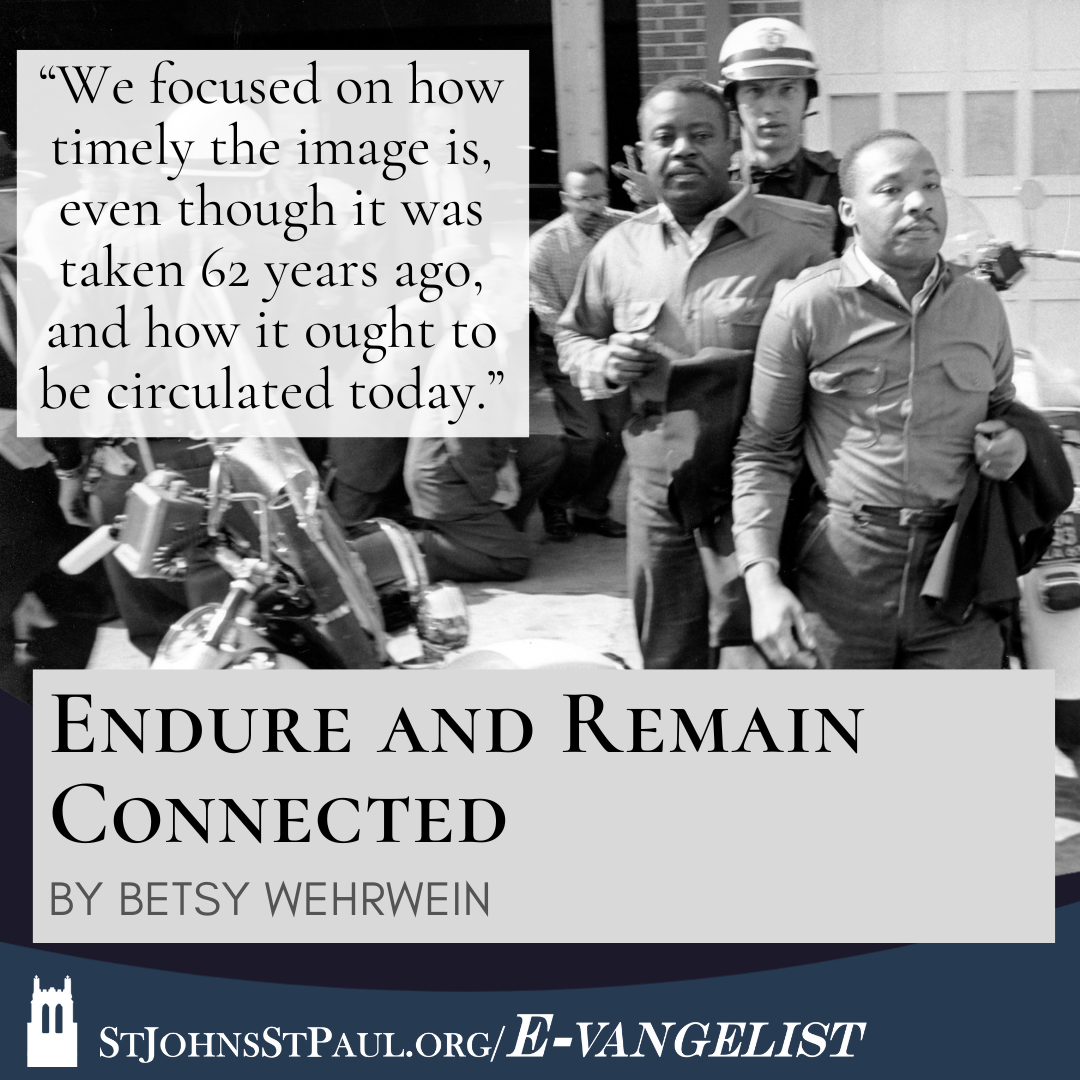
“But before all this occurs, they will arrest you and persecute you; they will hand you over to synagogues and prisons, and you will be brought before kings and governors because of my name. This will give you an opportunity to testify.”

You may have read a short synopsis of this article yesterday in our e-news; here is the full and powerful story of how two of our parishioners have found a source of joy and a means of advocacy through this project to combat Christian Nationalism, and how you can join them.

This Sunday, August 3, will be our family’s last Sunday at St. John’s before we move to Oxford, England. We believe this is the path God has for us and we are confident in our decision to leave, but it is still sad to leave this community after 14 years.

“By focusing on stories of inspiring, spiritual women, we are not excluding anyone. We are bringing out the mother in each of us.”