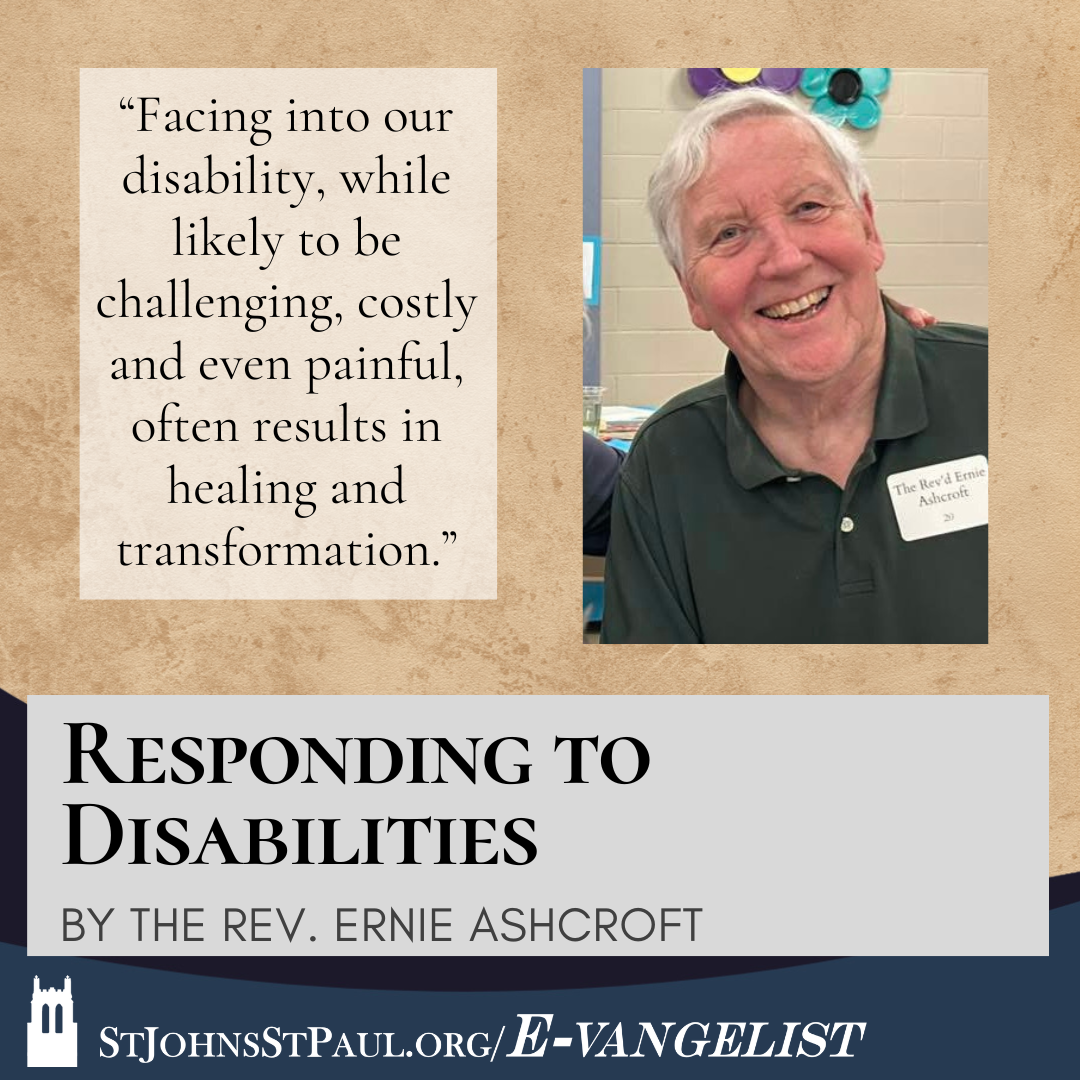
Responding to Disabilities
During my psychotherapy, I choose to explore the emotional side of my life. It was not an easy or a comfortable process, but the wholeness and healing that this brought was deeply satisfying.

During my psychotherapy, I choose to explore the emotional side of my life. It was not an easy or a comfortable process, but the wholeness and healing that this brought was deeply satisfying.

I have always thought of Jesus as someone with arms outstretched. True, he was on the cross, but also, he had a welcoming embrace. Children can grow up to be adults with outstretched arms, to know suffering, but also to know that they are not alone.

When I go out I am always masking, because the whole world is too noisy for me and I am in constant chronic pain. I am used to this. When I return home I am exhausted. But I still think it is important to go out, see the people I love, and do the things that interest me.

For me, this often means my usual focus is shrouded in fog as my brain attempts to chase after the perceived threats du jour, and tasks that appear easy at first brush are insurmountable mountains. To speak this aloud to God often reminds me of the Baptismal Covenant, when we assert that we will attempt to hold to our promises “with God’s help.” Sometimes, it’s enlisting God’s help to renounce evil; other times, it’s to ensure I eat food. Either way, I’m asking for the help.

It is hard to be your full, true self when you have to hide parts of who you are. But God made me this way for a reason, and I’ve learned to trust that.

We all agreed that wherever we landed, the church had to be Open: open hearts and minds, and open theologically. A church that rejected Ableism.

“A glorious example of how the Holy Spirit calls us together to create beauty in collaboration.”

Reclaiming the joy of church community does take effort. Forming a vibrant environment for our youth requires a conscious and challenging commitment to creating “safe space.”

by Allison Brown Indulge with me, for a moment, a brief bit of time travel as we go back to a Saturday morning in early

by Mary E. Johnson When Dorothy Day died in 1980, the New York Times eulogized her as “a nonviolent social radical of luminous personality.” Day