
by Mary E. Johnson
When Dorothy Day died in 1980, the New York Times eulogized her as “a nonviolent social radical of luminous personality.” Day was the founder of the Catholic Worker Movement at a time in United States history when millions of Americans were unemployed due to the Great Depression and the majority of immigrants entering the country were poor Roman Catholics. She led social justice battles for worker rights for more than 50 years.
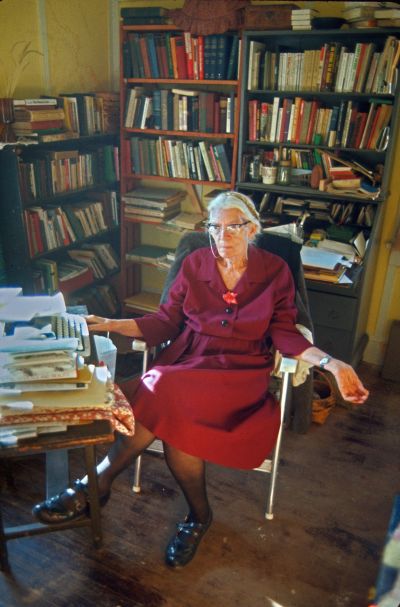
Photo courtesy of the Department of Special Collections, Stanford University Libraries.
Dorothy Day spent her early life as a journalist in the crucible of Greenwich Village and literary thought of the 1920s. Her conversion to Catholicism meant the end of a Bohemian lifestyle and a common-law marriage. Her passion for social justice moved her from covering strikes and rallies as a journalist to leading the charge, often risking injury and arrest.
Unstinting in her commitment to peace, non-violence, racial justice and the cause of the poor and the outcast, Dorothy Day became an inspiration to such activists as Thomas Merton, Michael Harrington, Daniel Berrigan, and Cesar Chavez. She is the epitome of the Divine Feminine.