
by Terri Fishel
On Sunday, July 19, Reverend Dr. Craig Lemming in his commentary on the Parable of the Weeds mentioned becoming “gardeners of hope.” Did his words make you consider what you could do to become a gardener of hope?
During this past winter, as I observed the actions of cruelty against targeted people in our cities, I often looked for opportunities to keep my hope alive, and that meant participating in nonviolent resistance. I felt part of a community. As stated by Bishop Loya in his November 2025 address to the Episcopal Convention: “Our work, like our ancestors in every other moment like this, is to form and tend small communities of practice, witness and resistance.” Resistance takes different forms for everyone, but I believe my real resistance work began last summer when I joined a local chapter of Christians Against Christian Nationalism (CACN).
Through CACN, I was introduced to work being done by ISAIAH/Faith in Minnesota and that led to participating in a gathering on December 13 in Minneapolis with about 5,000 other Minnesotans. All faiths, as well as individuals without faith communities, and a diversity of attendees that truly represented not only the whole of Minnesota, but all the beloved children of God, were present that day. The program was entitled Light in the Storm, and was intended for those who felt called to respond to the moment we are in, not with hate, but with love. It was a day of programs to help us address the hateful rhetoric and acts of those individuals who believe themselves to be Christian, but do not live the message of Christ to love our neighbors, feed the hungry, and help all who are in need.
Central to the program that day was the “People’s Agenda” which puts the dignity of every individual at the center of their plan to focus on actions that lead to economic, social and racial justice for everyone. The gathering took place just as Operation Metro Surge was expanding, and the original plans were quickly adjusted in a follow-up meeting on January 17. On that day about 350 participants heard of the plans for January 23rd, the Day of Truth and Freedom.
That day of action was done in cooperation with many other groups in the Twin Cities, but was organized as a faith-based initiative. January 23rd was laser-focused to stop business as usual for just one day and to engage in a show of nonviolent resistance and acts of civil disobedience to protest the acts of cruelty taking place in our state.

The results of that one day were powerful and gave me a sense of what we could accomplish when we work together and take public action that openly expresses the values of our faith. ISAIAH also organized a Palm Sunday Procession to the Capitol, where over 10,000 Christians marched to “reclaim a faith rooted in justice, not cruelty.”
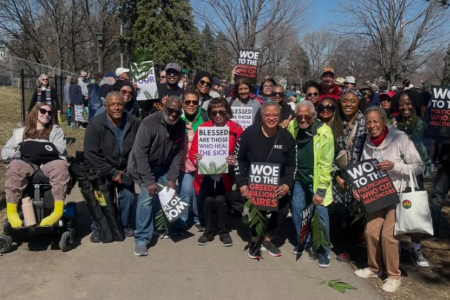
I wanted to do more. And shortly after the Palm Sunday march, I was invited to an opportunity to do more by living my faith “out loud.”
That opportunity, organized by ISAIAH/Faith in Minnesota, was a training program on public discipleship. They invited people to learn how to “facilitate a path where church members can meaningfully live their faith out loud and publicly in a broken world where hate and hurt should be challenged by love.” This was the opportunity I had been seeking. We were to learn how we could grow “communities of practice, witness, and resistance.” Most importantly I saw an opportunity to engage in Bishop Loya’s call to discipleship.
One of Bishop Loya’s priorities since he became our Bishop has been discipleship. Returning to our theme of gardening, on the ECMN webpage, you will find Discipleship described as “Tending to our roots, deepening into the soil of Jesus.” In his 2022 address, he stated that “discipleship is without question the keystone priority. That’s the only way that God will use us to grow the deep and thick root systems that can produce the fruits of justice.” He repeated this emphasis in his 2025 address:
“Discipleship—apprenticing our lives to the way of Jesus-–is the foundational priority from which everything else is possible. Focusing on how we tether our hearts fully to the living God is how we grow deep and strong roots to weather the fires that inevitably wash over us.”
John Mark Comer explains in Practicing the Way, the true meaning of discipleship is about becoming an apprentice and an apprentice is all about “mastering the art of living in God’s world by learning from Jesus.” [p11]
Six of us from St. John’s took part in the six-hour training on public discipleship and we were joined by many individuals from other congregations and faith communities across the state of Minnesota. As I listened and learned, my confidence grew and I knew this was an activity that I wanted to fully embrace because it addresses the moment we are in.
Consider how powerful it might be if we are successful in developing a committed group of individuals who grow in what it means to live a life more closely aligned to the teachings of Christ and take more public actions? This is more than resistance: this is an opportunity to create positive change in a meaningful way that is centered on our faith and is focused on improving the lives of others. We call our program, Love Out Loud. I hope as you learn more about what our program will offer, you will consider joining us on this journey. Consider this an opportunity to learn not only how to become a gardener of hope, but also a sower of seeds of love.